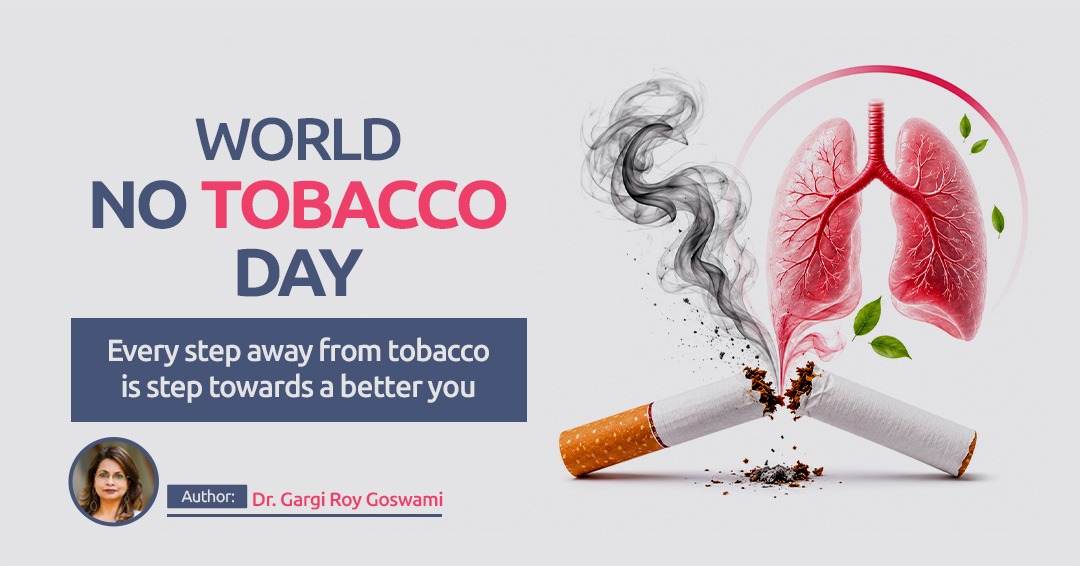
World No Tobacco Day - Every step away from tobacco is step towards a better you
The Smoke We Don't See
What Tobacco Quietly Does Inside Our Body
Every morning, outside hospitals, tea stalls, bus stops, and office buildings, we see the same scene.
Someone lights a cigarette with their morning tea.
Someone folds a packet of gutka into their pocket.
Someone says casually,
“I’ll quit one day.”
And life moves on normally.
People go to work
Attend meetings
Laugh with friends
Return home
Tobacco damage does not arrive like a storm.
It behaves more like water slowly leaking inside the walls of a house.
From the outside, everything may look perfectly fine for years.
But deep inside:
-
walls weaken,
-
pipes corrode,
-
structure begins to change.
That is how tobacco harms the body.
Not suddenly but steadily, day after day. And by the time symptoms appear, the damage is often deeper than we can imagine.
The Body Is Like a Beautiful City:
Our body is a beautifully functioning city:
-
Blood vessels are highways
-
Lungs are air purification plants
-
Brain is the control tower
-
Immune system is the police force
-
DNA is the city’s instruction manual
Now imagine toxic smoke entering this city every single day.
Not ordinary smoke from cooking fires, but smoke carrying more than 7,000 chemicals!
Many are poisonous. At least 70 are known to cause cancer.
Slowly:
-
roads begin to crack,
-
air filters stop working properly,
-
repair workers become exhausted,
-
communication systems fail.
And the most dangerous part?
The damage often begins years before any disease is diagnosed.
Nicotine: The Chemical That Tricks the Brain:
Most people think nicotine itself causes cancer.
Actually, nicotine is mainly an addictive chemical; it is the reason quitting becomes so difficult.
Think of nicotine like a clever salesman who keeps convincing the brain that tobacco is helping.
Within seconds of smoking:
-
nicotine reaches the brain,
-
dopamine, the “feel-good chemical", gets released,
-
our brain experiences temporary relief or pleasure.
The brain then remembers that feeling.
Over time, it starts demanding nicotine repeatedly.
This is how addiction develops.
Without nicotine, the brain suddenly feels:
-
restless,
-
anxious,
-
irritated,
-
unable to focus.
This is why tobacco addiction is not simply about “lack of willpower.”
It is a biological dependency involving real changes inside the brain.
What Actually Causes Cancer?
If nicotine is the hook, the real damage comes from the toxic chemicals released during tobacco use.
One major villain is something called free radicals.
Free radicals are like rust forming on metal.
A brand-new iron gate looks strong and shiny.
But when it is constantly exposed to moisture and pollution, tiny layers of rust slowly begin to form.
At first, the damage was barely visible.
Then gradually:
-
the surface weakens,
-
cracks appear,
-
and the metal loses its original strength.
Something similar happens inside our body.
Tobacco smoke creates chemical stress that slowly damages cells and their DNA - the instruction manual that tells cells how to behave properly.
Over time:
-
repair systems become less efficient,
-
mistakes begin to accumulate,
-
and some cells stop following normal rules.
Instead of growing in a controlled way, they begin multiplying uncontrollably.
That uncontrolled growth is cancer.
Tobacco smoke also creates chronic inflammation.
If you rub the same area of skin every single day for years, eventually the skin will become irritated, thickened, and damaged.
The same thing happens inside:
-
lungs,
-
mouth,
-
throat,
-
food pipe,
-
pancreas,
-
bladder,
-
and blood vessels.
The body keeps trying to repair the injury.
But continuous tobacco exposure overwhelms the system over time.
Smokeless Tobacco Is Not “Safe”
Many people believe:
“I don’t smoke. I only chew tobacco.”
Unfortunately, smokeless tobacco is also extremely harmful.
Gutka, khaini, zarda, paan with tobacco, and similar products continuously expose the mouth lining to cancer-causing chemicals.
It is like keeping a harsh chemical against delicate skin every single day.
Over time:
-
white patches may develop,
-
mouth opening may reduce,
-
tissues become stiff,
-
and precancerous changes can appear.
India carries one of the world’s highest burdens of oral cancer largely because of smokeless tobacco use.
What Happens When You Quit?
The beautiful thing about the human body is this:
It wants to heal.
Even after years of tobacco exposure, recovery begins surprisingly fast.
-
Within 20 minutes: heart rate starts improving.
-
Within 24 hours: carbon monoxide levels begin reducing.
-
Within weeks: blood circulation improves.
-
Within months: lungs function better.
-
Over years: cancer and heart disease risk gradually decreases.
The body responds to every step toward healing.
It is never “too late” to benefit from quitting.
The New Science of Tobacco De-Addiction:
For a long time, quitting tobacco depended mostly on “willpower.”
Today, science understands addiction much better.
Modern tobacco de-addiction combines:
-
brain chemistry,
-
behavioral support,
-
replacement therapies,
-
digital tools,
-
and medications.
People no longer have to fight addiction alone.
Nicotine Replacement Therapy (NRT) - Giving the Brain a Softer Landing:
One of the oldest and still most effective approaches is Nicotine Replacement Therapy.
Instead of cigarettes or tobacco:
-
controlled nicotine is provided through patches,
-
chewing gums,
-
lozenges,
-
inhalers,
-
or nasal sprays.
Think of it like gradually dimming bright lights instead of suddenly switching everything off.
This helps reduce:
-
cravings,
-
irritability,
-
anxiety,
-
and withdrawal symptoms.
Importantly, NRT provides nicotine without exposing the body to the thousands of toxic chemicals found in tobacco smoke.
Medicines That Reduce Cravings
1. Varenicline
This medicine works directly on nicotine receptors in the brain.
Nicotine receptors as parking spaces.
Varenicline partially occupies those spaces:
-
reducing withdrawal symptoms,
-
while also making smoking feel less satisfying.
So the brain slowly loses its strong reward connection with cigarettes.
2. Bupropion
Originally developed as an antidepressant, bupropion also helps reduce tobacco cravings.
It works on brain chemicals linked to:
-
mood,
-
motivation,
-
and addiction.
This becomes especially useful because many people smoke more during:
-
stress,
-
loneliness,
-
anxiety,
-
or emotional exhaustion.
What’s New and Emerging?
Digital De-Addiction Tools
Today, many quit-smoking programs use:
-
AI-based counseling,
-
mobile apps,
-
craving trackers,
-
wearable monitoring systems,
-
and WhatsApp-based support groups.
Research shows that frequent encouragement and continuous support improve quitting success significantly.
Cytisine: The Lesser-Known Plant-Based Molecule:
One of the newer discussions in tobacco de-addiction involves cytisine, a plant-derived compound used in some countries for smoking cessation.
It works somewhat similarly to varenicline by acting on nicotine receptors in the brain.
Researchers are exploring it because it may be:
-
effective,
-
affordable,
-
and useful for large public health programs.
Personalised Addiction Medicine:
Scientists are now studying why:
-
some people quit easily,
-
while others struggle repeatedly despite trying many times.
The answer may partly lie in:
-
genetics,
-
nicotine metabolism,
-
brain chemistry, and
-
emotional behaviour patterns.
Future tobacco treatment may become more personalised, where therapies are chosen based on an individual’s biological and psychological profile.
This is a rapidly evolving area of medicine.
The Emotional Side Nobody Talks About:
Many tobacco users are not chasing pleasure.
They are chasing:
-
relief,
-
pause,
-
comfort,
-
routine,
-
or emotional escape.
The cigarette during work stress.
The tobacco pouch after meals.
The smoke breaks during loneliness.
That is why successful quitting is not only about removing nicotine.
It is also about rebuilding different daily habits and emotional coping mechanisms.
A Message for Families:
Sometimes people say:
“If they really wanted to quit, they would quit.”
But addiction is far more complex than simple choice.
Support matters.
Not judgment.
Not shaming.
Not fear.
Simple things can help:
-
listening,
-
encouraging,
-
celebrating small progress,
-
accompanying someone to counseling,
-
and reducing triggers at home.
Recovery often happens one difficult day at a time.
This World No Tobacco Day:
Maybe awareness should begin not with frightening statistics, but with one simple realisation:
Every cigarette, every chew, every puff asks the body to fight a silent battle.
And yet the body keeps trying to survive.
The lungs continue breathing.
The heart keeps pumping.
The cells keep repairing damage.
Until one day they cannot anymore.
World No Tobacco Day is not about blaming people who use tobacco.
It is about helping people understand:
-
what tobacco is doing inside the body,
-
why quitting feels difficult,
-
and why asking for help is a sign of strength - not weakness.
Because sometimes healing begins with awareness.
And sometimes awareness begins with one conversation.
References
- World Health Organization – Tobacco Fact Sheet
- Centers for Disease Control and Prevention – Health Effects of Cigarette Smoking
- National Cancer Institute – Harms of Cigarette Smoking and Health Benefits of Quitting
- American Cancer Society – Guide to Quitting Smoking
- World Health Organization – Tobacco and Oral Health
- National Institute on Drug Abuse – Nicotine and Tobacco Research
- Cochrane Review – Nicotine Replacement Therapy for Smoking Cessation
- New England Journal of Medicine – Cytisinicline for Smoking Cessation
- Indian Council of Medical Research – Smokeless Tobacco and Oral Cancer in India