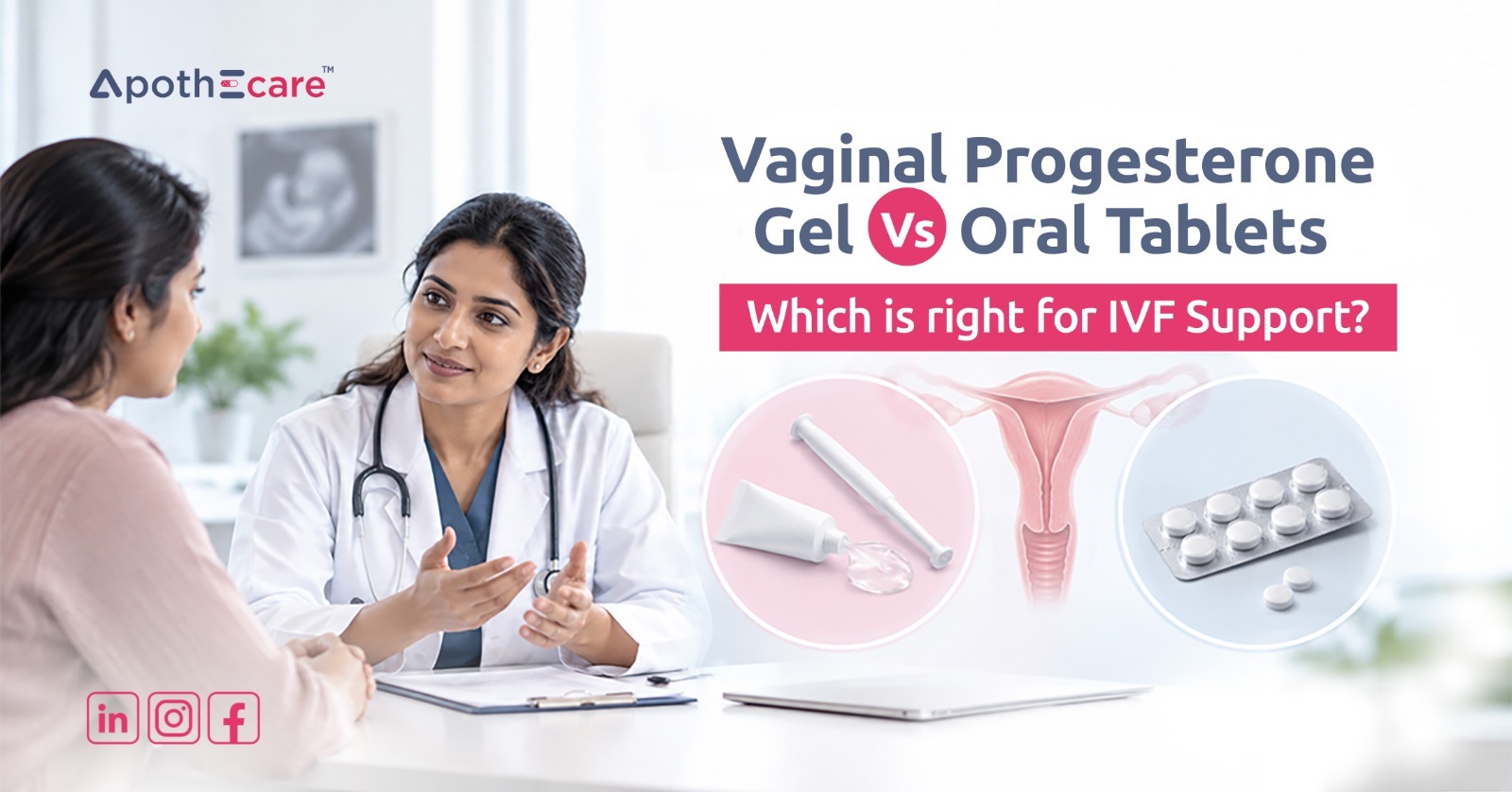
Vaginal Progesterone Gel vs Oral Tablets: Which Is Right for IVF Support?
IVF is full of questions, and one that comes up a lot is about progesterone support.
Usually doctors give you progesterone after egg retrieval and embryo transfer. Why is that? It prepares your uterus for the embryo and maintains the integrity of the uterine lining during those vital first days. For most people going through IVF or ICSI, progesterone for luteal phase support is standard practice.
But then there’s the big question: should you use vaginal progesterone gel or oral tablets?
Honestly, the answer isn’t the same for everyone. Your doctor will look at your IVF protocol, medical history, and which medicine works best for you before making a recommendation.
First, a little background. Progesterone is a key player in pregnancy. It gets the uterus ready for implantation and keeps the lining strong after ovulation and in early pregnancy. During IVF, your body’s natural progesterone might not be enough, so doctors add extra support just to be safe.
You can take progesterone a few ways—by mouth, through the vagina (often as a gel, like Emprogest 8% gel), or by injection. Vaginal gels and tablets both get the hormone where it needs to go, but how you take it, how effective it feels, and possible side effects can be different.
Some people prefer the vaginal gel because it delivers progesterone right where it needs to be, sometimes with fewer systemic side effects compared to oral tablets. Most people use Emprogest 8% gel for this. Oral tablets are simple to take, but they don’t work the same for everyone—some women just don’t absorb them well. Others mention side effects like feeling tired or a shift in mood.
Side effects for vaginal progesterone gel can include local irritation, discharge, or mild discomfort, but for most, these are manageable.
So if you’re choosing between the gel and oral tablets, talk it over with your fertility specialist. They’ll help you weigh the options and pick what fits best with your health history and treatment plan. But they are not the same medicine.
For example, Emprogest 8% vaginal gel contains natural micronized progesterone 8% w/w. It is a prescription medicine.
Oral tablets used for IVF support may contain dydrogesterone. This is different from natural micronized progesterone.
Quick comparison
|
Feature |
Vaginal progesterone gel |
Oral progesterone tablets |
|
Route |
Inserted into the vagina |
Taken by mouth |
|
Common example |
Emprogest 8% gel |
Dydrogesterone tablets |
|
Main use |
Luteal phase support |
Luteal phase support |
|
Local effects |
Discharge, irritation or burning may occur |
Usually no local vaginal effects |
|
Convenience |
Needs vaginal application |
Easy to take by mouth |
|
Dose |
Depends on the prescribed product |
Depends on the prescribed tablet |
|
Best choice |
Decided by fertility specialist |
Decided by fertility specialist |
Important: Do not compare medicines only by their route. The active ingredient, dose, and IVF protocol also matter.
What are the benefits of vaginal progesterone gel?
Vaginal progesterone is a way to get progesterone through the vagina.
This route is widely used for IVF luteal support. Current ESHRE guidance allows non-oral natural progesterone routes for luteal phase support. Vaginal progesterone gel is one of the listed options.
Possible benefits
· Easy to use at home.
· Provides local vaginal delivery of progesterone.
· Avoids swallowing a tablet.
· Can be used once daily for some 8% gel products when prescribed.
Possible side effects
Some women may notice:
· Vaginal discharge
· Mild irritation
· Burning or itching
· Breast tenderness
· Bloating
· Tiredness
Side effects can vary from person to person.
What about oral tablets?
· Some IVF clinics use oral dydrogesterone for luteal phase support.
· Dydrogesterone is a progestogen. It is different from natural micronized progesterone.
· Current ESHRE guidance says dydrogesterone can be used for luteal phase support.
· Oral treatment can be convenient. You simply take the tablet as prescribed.
· However, the right dose and duration depend on your IVF protocol.
Never replace vaginal progesterone with an oral tablet on your own.
How to use vaginal progesterone gel correctly
If your doctor has prescribed a vaginal progesterone gel:
1. Wash your hands before use.
2. Follow the instructions on the pack.
3. Just insert the gel as your doctor shows you.
4. If they tell you to use it at the same time every day, stick to that schedule.
5. Wash your hands after use.
6. Do not use extra gel if you miss a dose.
7. Ask your doctor what to do after a missed dose.
Some products recommend storage below 25°C, away from light and moisture. Always follow the storage instructions on your own pack.
A small amount of discharge after vaginal gel use can occur. This does not always mean that the medicine has not worked.
5 FAQs about progesterone support in IVF
1. Is vaginal progesterone is better than tablets?
Not always. Both can be used in IVF. Honestly, it depends—your medication, dose, your IVF protocol, and what your doctor thinks all play a role.
2. Can I switch from vaginal gel to tablets?
Do not switch on your own. Different progesterone medicines are not automatically equal in dose or effect.
3. Is vaginal discharge normal after progesterone gel?
That’s usually normal, but if it gets heavy, happens with pain, irritation, or bleeding, talk to your doctor right away.
4. How long should progesterone be used after IVF?
The duration varies by IVF protocol. ESHRE guidance recommends progesterone support at least until the pregnancy test. Your fertility clinic may advise a longer duration.
5. If I have a positive pregnancy test can I come off progesterone?
No. Do not stop it without speaking to your fertility specialist. Your doctor will decide when it should be stopped.
The bottom line
There is no single progesterone option that is right for every IVF patient.
Vaginal progesterone gel may be useful when vaginal progesterone is part of the clinic's treatment plan. Oral tablets, such as dydrogesterone, may be another option in some IVF protocols.
The important points are the right medicine, right dose, right timing, and regular use.
If you have been prescribed Emprogest 8% gel, use it exactly as directed by your fertility specialist. Do not change the route or dose without medical advice.
Disclaimer: This article is for general information only. It does not replace advice from your fertility specialist.
IVF Progesterone Support: What Is It, What Is It For, Side Effects & FAQ
1. Is vaginal progesterone better than tablets?
2. Can I switch from vaginal gel to tablets?
3. Is it normal to have vaginal discharge after progesterone gel?
4. How long should progesterone be used after IVF?
5. Can I stop progesterone after a positive pregnancy test?
If you’re deciding between vaginal gel and oral tablets for IVF, your doctor can explain the benefits, possible side effects, and how to use each one. If you have questions, ask—no one expects you to figure this out alone.